Make a Face Wooden Puzzle Laser Cut CNC: A Creative Educational Tool
In the evolving landscape of educational resources and creative woodworking, digital design files have revolutionized how we create interactive learning tools. Among these innovations, the Make a Face Wooden Puzzle Laser Cut CNC stands out as a versatile project that bridges the gap between technology, craftsmanship, and child development. This digital product is not merely a set of lines on a screen; it represents a comprehensive system for creating tangible, engaging toys that foster social-emotional learning (SEL) and fine motor skills. Whether you are a Montessori educator, a hobbyist woodworker, or a parent seeking meaningful activities, understanding the potential of this template can unlock new avenues for creativity and education.
The Intersection of Craft and Cognitive Development
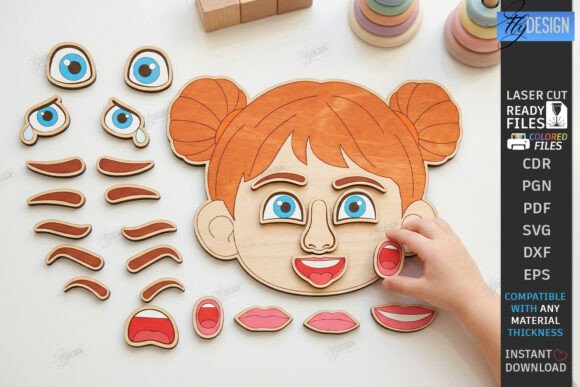
The core value of the Make a Face Wooden Puzzle Laser Cut CNC lies in its dual purpose: it serves as a precise manufacturing guide for laser cutters and as a robust framework for educational play. Unlike static puzzles, this design focuses on human anatomy and expression. By allowing children to mix and match eyes, noses, mouths, and eyebrows, the puzzle transforms into an interactive "My Emotions Board." This interactivity is crucial for preschoolers who are just beginning to navigate the complex world of feelings.
When implemented correctly, this tool supports Social Emotional Learning. Children learn to identify their own emotions and recognize them in others by physically assembling different facial configurations. For instance, combining a frowning mouth with wide eyes might represent surprise or fear, while a smiling mouth with raised cheeks indicates happiness. This tactile approach aligns perfectly with Montessori principles, which emphasize hands-on learning and self-directed exploration. The result is a Cognitive Body Parts Vocabulary Game that makes abstract concepts concrete and memorable.
Technical Specifications and File Formats
For professionals and creators utilizing laser cutting machines, the technical integrity of the design files is paramount. The Make a Face Wooden Puzzle Laser Cut 3D Educational package is designed to be compatible with standard industry software. It typically arrives as a zip archive containing multiple file formats to ensure versatility across different workflows:
- SVG (Scalable Vector Graphics): Ideal for most modern laser cutter software, offering scalability without loss of quality.
- EPS (Encapsulated PostScript): A robust vector format often used in professional graphic design and older laser systems.
- DXF (Drawing Exchange Format): Widely supported by CAD software and CNC routers, making it essential for precision cutting.
- PNG (Portable Network Graphics): Useful for visualizing the final product or printing reference guides.
- PDF (Portable Document Format): Provides a scalable document view and often includes assembly instructions.
A critical aspect of using these files is understanding the color coding within the vector designs. In this specific layout, the RED line indicates CUT paths, instructing the machine to sever the material completely. Conversely, the BLACK line indicates ENGRAVE paths, guiding the laser to etch details such as texture, labels, or decorative elements onto the surface of the wood. Ensuring your cutting machine and software are configured to interpret these colors correctly is the first step toward a successful production run.
Material Selection and Production Considerations
While the design is digital, the physical outcome depends heavily on material choice. Plywood is the most common substrate for this type of project due to its stability and clean burning characteristics under a laser. However, the thickness of the plywood must be carefully matched to the kerf (the width of the cut) of your specific laser cutter. If the wood is too thick relative to the power of the machine, the pieces may warp or fail to separate cleanly. Conversely, wood that is too thin may burn excessively or lack the durability required for repeated handling by children.
For those considering a Laser Cut Files for Woodworking project, safety is also a primary concern. Always ensure proper ventilation when cutting wood, as the process releases fumes. Furthermore, post-processing is often necessary. After cutting, edges may require light sanding to remove char marks and ensure smoothness, preventing splinters. This finishing touch is vital for a Sensory Fine Motor Toy, where the tactile experience should be pleasant and safe for young hands.
Real-World Applications and Scenarios
The utility of the Make a Face Wooden Puzzle Laser Cut CNC extends beyond simple playtime. It finds valuable application in various settings:
- Montessori Classrooms: Teachers can use these boards to facilitate group discussions about feelings. Students take turns building faces that represent how they feel that day, fostering empathy and communication skills.
- Therapeutic Environments: Occupational therapists utilize similar tools to help children with autism spectrum disorders or speech delays express emotions non-verbally. The clear, distinct parts reduce cognitive load, making it easier for the child to focus on the emotion itself.
- Home Education: Parents can engage in bonding activities by creating stories based on the faces their children build. "What happens if Mr. Bear looks sad? How can we make him happy?" Such questions encourage narrative thinking and problem-solving.
- Small Business Ventures: Entrepreneurs can produce these puzzles as high-quality, eco-friendly gifts. The ability to customize the size and finish allows for niche marketing towards parents seeking non-plastic alternatives.
Evaluating Suitability for Your Project
Before diving into a production run or purchasing the files, it is essential to evaluate whether this specific design meets your needs. Consider the target age group. While the concept is universal, the complexity of the pieces and the safety requirements vary. For very young toddlers, larger pieces with rounded corners are preferable to prevent choking hazards. The Kids Creative Face Change Vector Files provided in this package usually allow for scaling, but one must ensure that scaling up does not compromise the structural integrity of the tabs and slots.
Additionally, consider the capabilities of your equipment. If you are using a lower-wattage diode laser, cutting thicker plywood might be time-consuming or ineffective. In such cases, thinner birch plywood (e.g., 3mm or 4mm) is recommended. For CO2 lasers with higher wattage, you have more flexibility with material thickness. Always perform a test cut on scrap material to verify speed and power settings before committing to expensive stock.
Overcoming Limitations and Enhancing Value
No digital product is without limitations. One common challenge is the variability of wood grain. Natural materials like plywood have inherent inconsistencies that can affect the engraving quality. Dark knots or resin pockets may absorb more laser energy, leading to uneven burns. To mitigate this, selecting high-grade plywood with minimal defects is advisable. Another consideration is the longevity of the toy. Over time, frequent handling can wear down the edges. Applying a food-safe oil or wax finish can protect the wood and enhance the sensory experience, giving the puzzle a warm, polished feel.
If you find that the standard file formats do not suit your specific workflow, or if you require a different resolution for the PNG preview images, communication with the creator is key. Many designers offer support for custom requests, such as converting files to alternative formats or adjusting the dimensions of the output. Remember, the goal is to create a functional, beautiful product that serves its educational purpose effectively.
Conclusion: Empowering Creators and Educators
The Make a Face Wooden Puzzle Laser Cut CNC represents more than just a digital download; it is a catalyst for connection, learning, and creativity. By leveraging the precision of modern laser cutting technology, users can produce high-quality, durable educational tools that resonate with the developmental needs of children. From enhancing vocabulary and emotional intelligence to providing a satisfying woodworking project for makers, the applications are vast.
As you embark on creating your own version of this puzzle, remember that attention to detail—from file preparation to final sanding—makes all the difference. Whether you are a seasoned professional or a beginner exploring the world of CNC routing, this project offers a rewarding blend of technical skill and human-centric design. By bringing these patterns to life, you contribute to a growing movement of thoughtful, sustainable, and engaging educational resources. Thank you for exploring the possibilities of this unique template, and we look forward to seeing the wonderful creations you bring into the world.